The Second International Conference on Cities and Universities highlights the role of culture as a driver of social progress
Barcelona, March 5, 2025 – The Second International Conference on Cities and Universities, under the theme Culture, Cities, and Universities: A Virtuous Triangle for Social Progress, was held on March 5 at the Open University of Catalonia (UOC) Auditorium, in Barcelona. The event gathered over 120 attendees, both in person and online (with streaming in English and Catalan), to discuss the fundamental role of culture as a pillar of social cohesion and progress, through the collaboration between cities and universities. The event, organized by the Global University Network for Innovation (GUNi) with support from the Government of Catalonia, the City Council of Barcelona, the Barcelona Provincial Council, the Ministry of Culture, and the “laCaixa” Foundation, highlighted culture in a broad sense, including science and knowledge, as crucial factors for well-being and democracy.
During the welcome speech, Àngels Fitó, Vice President of the ACUP (Catalan Association of Public Universities) and Rector of the UOC, emphasized the importance of generating and sharing knowledge through exchange and shared spaces, such as the European project led by UOC in collaboration with the Open University. She used UOC as an example of a university where culture is seen as an essential and original element, and where knowledge is conceived as culture. Jordi Valls, Deputy Mayor for Economy, Finance, Economic Promotion, and Tourism at the City Council of Barcelona, highlighted that culture is an invitation to reflection, beyond its immediate usefulness or commercialization. He recalled the importance of research and science, in which Barcelona invests extensively, but stressed the need to not forget the humanities and give them more relevance to share knowledge and improve as people.
The first session was a dialogue titled “Why is culture essential for societal progress?”, featuring Marina Garcés, philosopher and professor at UOC, and Jordi Martí, Secretary of State for Culture of the Spanish Government. Martí emphasized that we can all be facilitators of culture and stressed the need to bring it closer to everyone. He spoke about the importance of connecting universities and libraries to make them places where anyone feels comfortable and where trust can be regained to enter and use these spaces. Marina Garcés, on the other hand, highlighted successful projects such as school of philosophy in public libraries and underscored the importance of having time to think and do things better, a key element for enriching culture and knowledge.
The conference also featured an inspiring presentation by Mónica Bello, art historian and curator, who spoke about “The Nature of Things and the Forms of Addressing Uncertainty”. Bello highlighted the case of CERN (European Organization for Nuclear Research), a project that establishes residences where artists and scientists coexist to promote interdisciplinary collaboration between art and science. She emphasized that “every laboratory in the world is a place where artists should go” and presented examples of global initiatives for art-science collaboration, such as in India, Atacama (Chile), and South Africa, in addition to discussing citizen science as a new way of generating knowledge inclusively and participatively.
Throughout the conference, enriching perspectives on the relationship between culture, universities, and cities were shared. Eva Sòria, Director of Cultural Sectors at the Barcelona Institute of Culture, spoke about the creation of 12 creative spaces in Barcelona, emphasizing the importance of having time to think and build deeper reflections in creative processes. Sòria pointed out that, despite progress, “there is still much to be done,” noting that “we don’t have an established joint and systematic line of action between cities and universities,” and highlighted that “cities are key agents for citizens to access culture.”
Manel Jiménez, Vice-Rector for Alliances, Community, and Culture at UOC, proposed a profound reflection: “The university is attributed to science, but why not also culture?” This question opens an interesting debate on the fundamental role universities can play in the creation and dissemination of culture. Martina Massana, a Data Engineering student at the Polytechnic University of Catalonia (UPC), presented initiatives such as U!Reading Club, the first interuniversity reading club in Europe, a project she co-founded with two other students.
In this regard, Miha Kovač, Professor at the University of Ljubljana (Slovenia), emphasized the importance of reading complex texts to develop the brain and foster deep understanding. He criticized the pragmatism of contemporary academia and warned that the drive to change things quickly may diminish the quality of deep reflection. Another key point was the bureaucracy within universities, which often hinders innovation. Kovač also pointed out that, despite efforts in literary festivals, they are still considered an almost “hobby” activity, with only 10% of funding from cities, showing that current collaborations are not enough to truly foster culture. This panel also stressed the importance of opening university spaces to the public, from all backgrounds or statuses, to make culture an integrative and mediating tool.
Another highlight was the presentation by Daniel Valtueña, cultural consultant and university professor, who shared his doctoral project from Queen’s, New York, exploring how university and doctoral projects can invite local residents to actively participate in cultural initiatives, designating them as “art commissioners.” These residents are compensated for their contributions to the projects, creating a sense of belonging and valuing their effort, knowledge, and time. Belinda Dillon, director of the Creative Arc program in the UK, emphasized the importance of not fearing failure. She stated that local authorities should learn from artists, who are often willing to take risks and experiment. Similarly, Asier Larrinaga from the Bilbao City Development Area, Jeroen Bourgonjon, co-founder of COMON and professor at the University of Ghent, and Belinda Dillon presented successful cases of collaboration between cities and universities in their regions and beyond, offering practical examples of how these synergies can generate a real and positive impact on communities. They also highlighted the importance of communities and how essential it is for people to feel invited to participate in cultural initiatives and build trust within the community.
The conference concluded with an open debate on how to create culture with and for society, featuring international initiatives that bring science, research, and art closer to citizens interactively. The final session included Mónica Bello, Gemma Segarra, General Coordinator of the Manifesta 15 Foundation in Barcelona, and Carlotta Cataldi, visual artist, who enriched the debate with their unique perspectives on interdisciplinary collaboration and the importance of building bridges between culture, art, and knowledge.
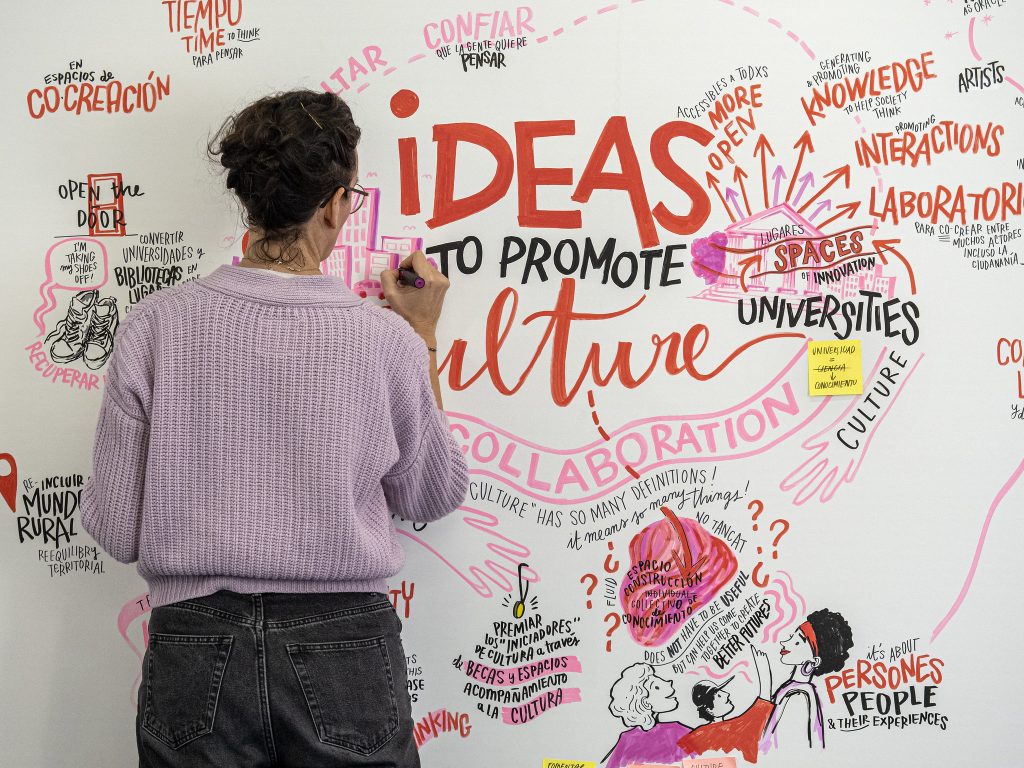
All the topics, ideas, and proposals that emerged during the day were graphically collected in a mural created by Carlotta Cataldi, which served as a tool to share and disseminate clear examples or ideals of collaboration between cities and universities to create and spread culture.
With a clearly international and interdisciplinary focus, the Second International Conference on Cities and Universities allowed for a deeper exploration of the relationship between cities, universities, and culture, establishing connections that enable these institutions to contribute to the construction of a more just, sustainable, and innovative society.
For more information:
- The streaming recordings:
In English
In Catalan
Original version (different interventions were in Catalan, Spanish, and English) - The programmes and speakers:
In Catalan
In Spanish
In English - Image gallery: https://flic.kr/s/aHBqjC4Hsd