FOBZU annual conference calls for emergency academic support in Gaza: “Education is a Lifeline”
London, June 27, 2025
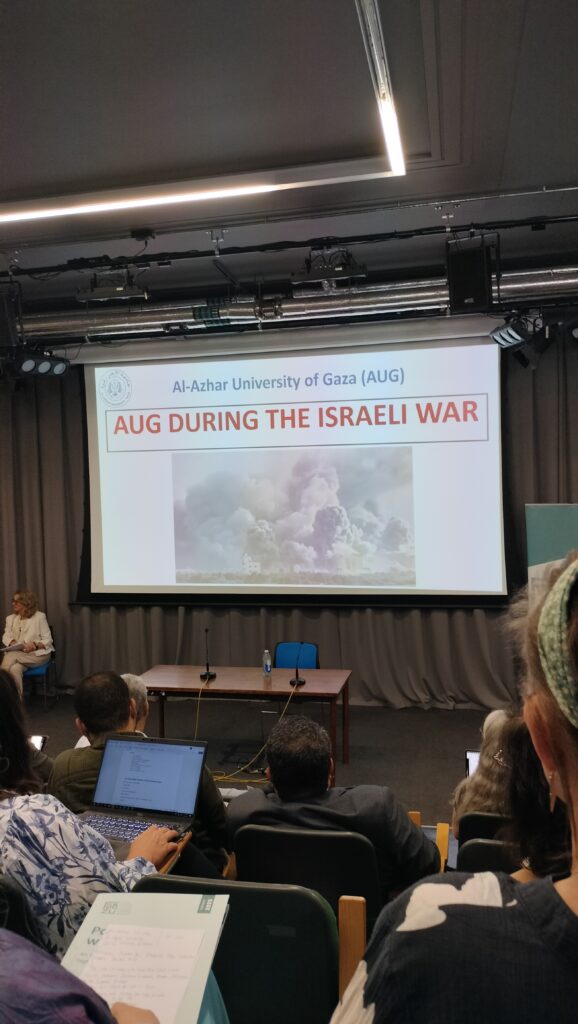
The Friends of Birzeit University (FOBZU) Annual Conference, held in London under the theme “Emergency Support for Palestinian Higher Education: The Role of the International Academic Community”, brought urgent attention to the catastrophic situation of universities in Gaza and called on the global higher education community to act decisively.
The conference highlighted the resilience of Gaza’s higher education institutions, which continue to function despite severe challenges. With campuses destroyed, universities now operate exclusively online, even though students lack electricity, internet access, and basic digital devices. The sector has suffered millions of dollars in losses, with students unable to afford administrative fees or access to technology.
“Education in Gaza is not just a right, it’s a lifeline,” speakers emphasized.
Despite the war, universities have refused to close their doors. Institutions continue to provide access to students who cannot pay tuition, and the academic community in Gaza remains determined to teach and learn — even under bombs. FOBZU, in collaboration with students and academics in Gaza, created a short film to raise awareness about this situation and honour the right to education as a cornerstone of hope and freedom.
Dire challenges and systematic attacks
Participants described how academic freedom is under attack, with student associations criminalized under Israel’s Military Order 101 (1967), which bans gatherings of more than ten people discussing political topics. More than 80 students are currently detained, and over 30 families have no information on their children’s whereabouts. Social media is monitored, and individuals are persecuted for speaking out.
“They are destroying institutions to destroy the system,” one speaker stated, underscoring the targeted nature of attacks on Gaza’s academic infrastructure.
Conference participants spoke of trauma, starvation, and daily war symptoms experienced by both students and staff. A new term was widely discussed — “Scholasticide” — referring to the systematic erasure of education through the destruction of universities and the killing of students and faculty.
Support and solidarity: what’s needed now
The conference issued a clear call to action:
- Rebuild infrastructures and campuses
- Provide electronic devices and internet connectivity
- Fund local scholarships (noting that $100,000 — the cost of relocating one student — could support 100 students in Gaza)
- Offer psychosocial and academic support for traumatized students and educators
“Students continue studying not because they see a future, but to resist and keep hope alive,” said one representative.
Speakers emphasized the importance of supporting higher education institutions not only as educational entities, but as pillars of resistance and social cohesion. They also criticized the broader context of colonialism and international complicity, pointing to the role of powerful Western states in perpetuating the crisis.
A long legacy of feminist and student activism
The event also highlighted the long tradition of Palestinian student and feminist activism, which dates back to the 1960s and 70s. These movements have historically defended freedom of expression and the right to self-determination, and continue to play a vital role in calling for justice and liberation today.
“Palestine’s struggle is connected to the global order. The academic community worldwide must speak out,” was the recurring message.
International mobilization ahead
FOBZU continues its advocacy work in support of education in Palestine. They recently published a guide on solidarity partnerships between higher education institutions, launched at the University of Oxford in May 2025, and are continuing to produce reports and organise international events to highlight violations of the right to education.
FOBZU is seeking partnerships — including with networks like GUNi and UNESCO Chairs — to amplify the report’s findings and ensure that recommendations translate into action.
In this regard, the Catalan Association of Public Universities (ACUP) has also sent this month a letter sent a letter on July 1, 2025, to Mariya Gabriel Ivanova, European Commissioner for Innovation, Research, Culture, Education and Youth, expressing deep concern over the participation of Israeli institutions in Horizon Europe projects.ACUP (universities that promoted GUNi) urges European Commission to suspend Israeli institutions from Horizon Europe projects.